
Description
Size: 23×13 mm / 0.91×0.51 in
Weight: ~ 3,8 g / 0.13 ozIcon pendant “St. Spyridon, Bishop of Trimythous”
This miniature scapular is a great gift for someone who wishes to have a portable icon of their patron saint. Due to its small size, the icon pendant “St. Spyridon, Bishop ...of Trimythous” is inconspicuous and convenient to wear. It can easily be concealed under one’s clothes or be worn on a casual basis without attracting undue attention.
Symbolism of the icon pendant “St. Spyridon, Bishop of Trimythous”
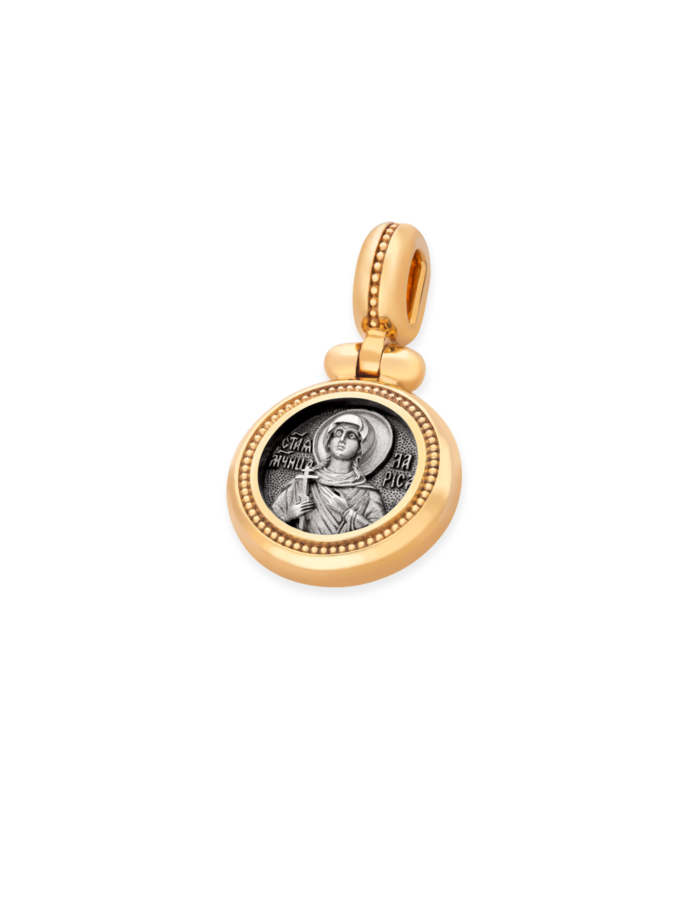
The round scapular contains a chest-length relief image of St. Spyridon, Bishop of Trimythous, depicted in a three-quarter turn. The iconographic image is based on a popular Greek interpretation. The saint is wearing a woven willow wicker hat and a bishop’s omophorion over his shoulders. The remaining free space on the scapular contains the name of the saint.
St. Spyridon the Miracle-Worker, Bishop of Trimythous, was born around 270 A.D. on the island of Cyprus, in the village of Askiyah near Trimythous. His parents were ordinary peasants.
The story of his life is remarkable in its simplicity and the power of the miracles he performed. He healed the sick, revived the dead, brought rain down onto the fields, tamed the elements, cast out demons and crushed idols.
Spyridon was a shepherd ever since he was a boy. He used all of his modest earnings to help his neighbors and wandering pilgrims. Though uneducated, the saint had a sound mind was granted wisdom and discernment by the Lord. As a young man, he married an honest and chaste girl and she had a daughter by him. Unfortunately, his wife died soon afterward, but the saint was not disheartened and did not fall into despair. Instead, he continued to minister to the Lord and to other people with an even greater zeal. For this, the inhabitants of Trimythous unanimously elected Spyridon as their bishop. Having become a Church hierarch, he continued to work as a shepherd. St. Spyridon was known for his kindness and showed great care for both his sentient and non-sentient flock.
In 325 A.D. St. Spyridon took part in the First Ecumenical Council, which condemned the heresy of Arianism. While arguing against the heretics, he performed a miracle that served as visible proof of unity within the Holy Trinity. He took a brick into his hands, squeezed it and separated the substance into three components. The fire came out of the brick, the water flowed out and the clay remained in the hands of the miracle-worker. “These are three elements, whereas the brick is one,” said the saint. “The Holy Trinity is the same: One Deity in Three Persons.”
St. Spyridon died in prayer around 348 A.D. His relics are unique in that they were preserved without any trace of decay and retained the properties of living flesh. The tissues are soft and are characterized by the regular temperature of a human body. In 1460 the saint’s relics were taken to the Greek island of Corfu, where they remain to this day.
On the day the memory of the saint is celebrated, his body is carried around the entire island. According to the Greek custom, the relics are seated in the episcopal armchair and accompanied by a procession.
In Russia, St. Spyridon is venerated alongside his contemporary, St. Nicholas, Archbishop of Myra in Lycia. The two saints are held in equally high esteem. Like St. Nicholas the Miracle-Worker, St. Spyridon is seen by the Orthodox as an ideal of holiness – “consoler of the desolate”, “defender of the orphaned”, “healer of the infirm”, “helper in times of trouble and tribulation”.
St. Spyridon of Trimythous is commemorated on 12 (25) December.
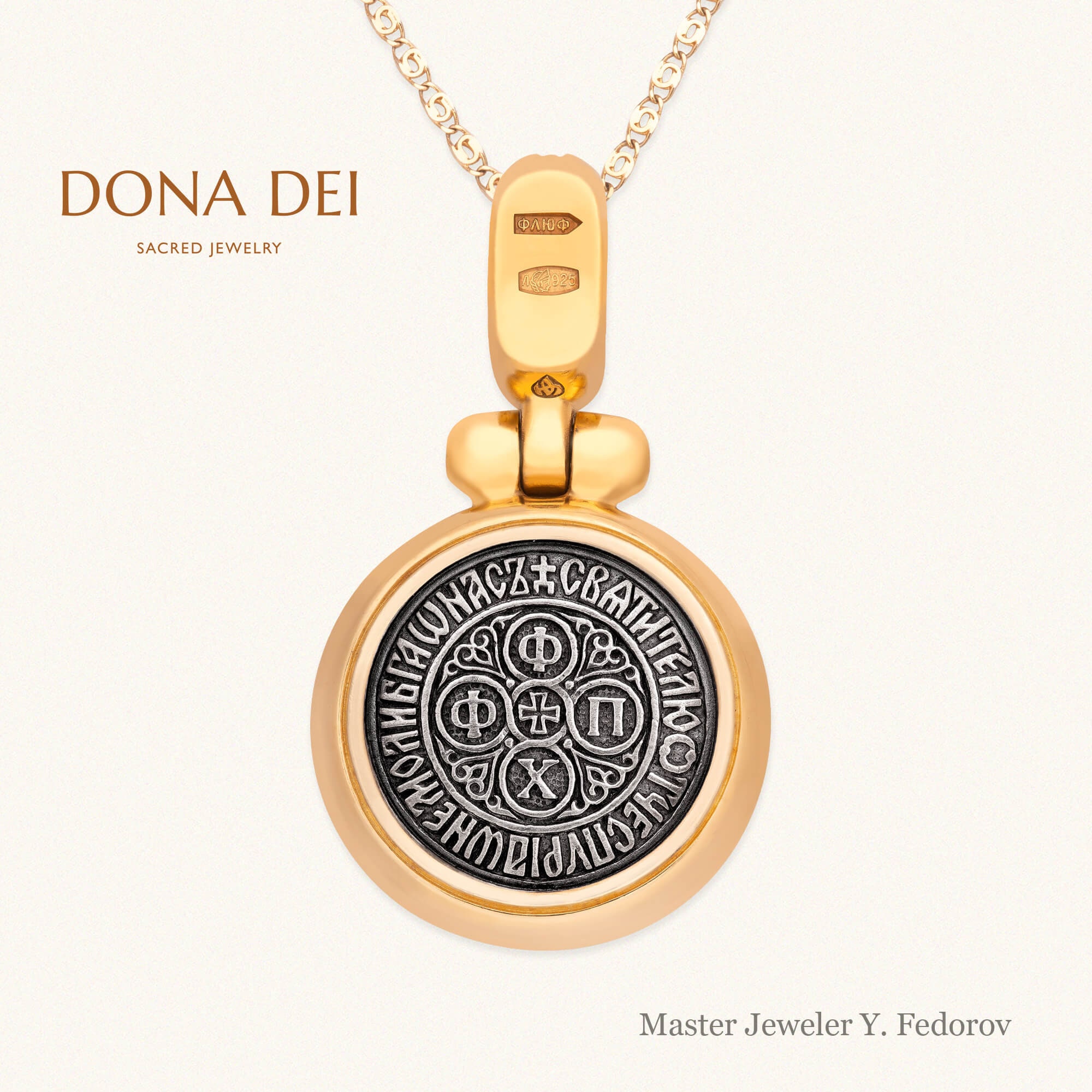
The reverse of the icon depicts an equilateral cross consisting of five circles. The circles contain four Greek letters which form the cryptogram ΦΧΦΠ, an acronym for the Greek phrase Φως Χριστού Φαίνει Πάσι (the light of Christ enlightens all). The cryptogram can be encountered on some of the crosses found on the omophoria of the holy hierarchs. The cross is surrounded by the words of the prayer to St. Spyridon in Church Slavonic: “O Holy Bishop, father Spyridon, pray to the Lord on our behalf”.
Technical details of the icon pendant “St. Spyridon, Bishop of Trimythous”
The icon pendant is round, with a relief image decorated with blackening. It is fashioned from grade-925 sterling silver and covered in 25k gold at the top and around the rim. The top part of the icon has a movable hoop for a chain. The pendant is quite small (only 0.91×0.51 in / 23×13 mm) and weighs only 0.13 oz (3.8 g). This makes it comfortable to wear either on or under one’s clothes.
About Master Jeweler Yuri Feodorov
Yuri Feodorov has spent over 35 years working with small sculptural items of an iconographic nature. He has created several collections of personal sacred items produced using a special casting technique, including cross pendants, scapulars and foldable icons. In addition, the artist has studied ancient Russian and Byzantine art and participatied in archaeological expeditions and thematic exhibitions of Orthodox artwork.
Y. Feodorov’s collection is constantly exhibited at jewelry exhibitions and exhibitions of Orthodox items in Russia and abroad.
The artist’s work has received numerous awards, including several orders from the Carl Faberge Memorial Foundation. Y. Feodorov has repeatedly received incentives from the Russian Orthodox Church and the Ministry of Culture of the Russian Federation and won prizes at various exhibitions and contests.
It is important to mention that this item is made in Y. Feodorov’s workshops and together with the hallmark imprinted on the item it also has the passport of authenticity (shown in the picture).