Description
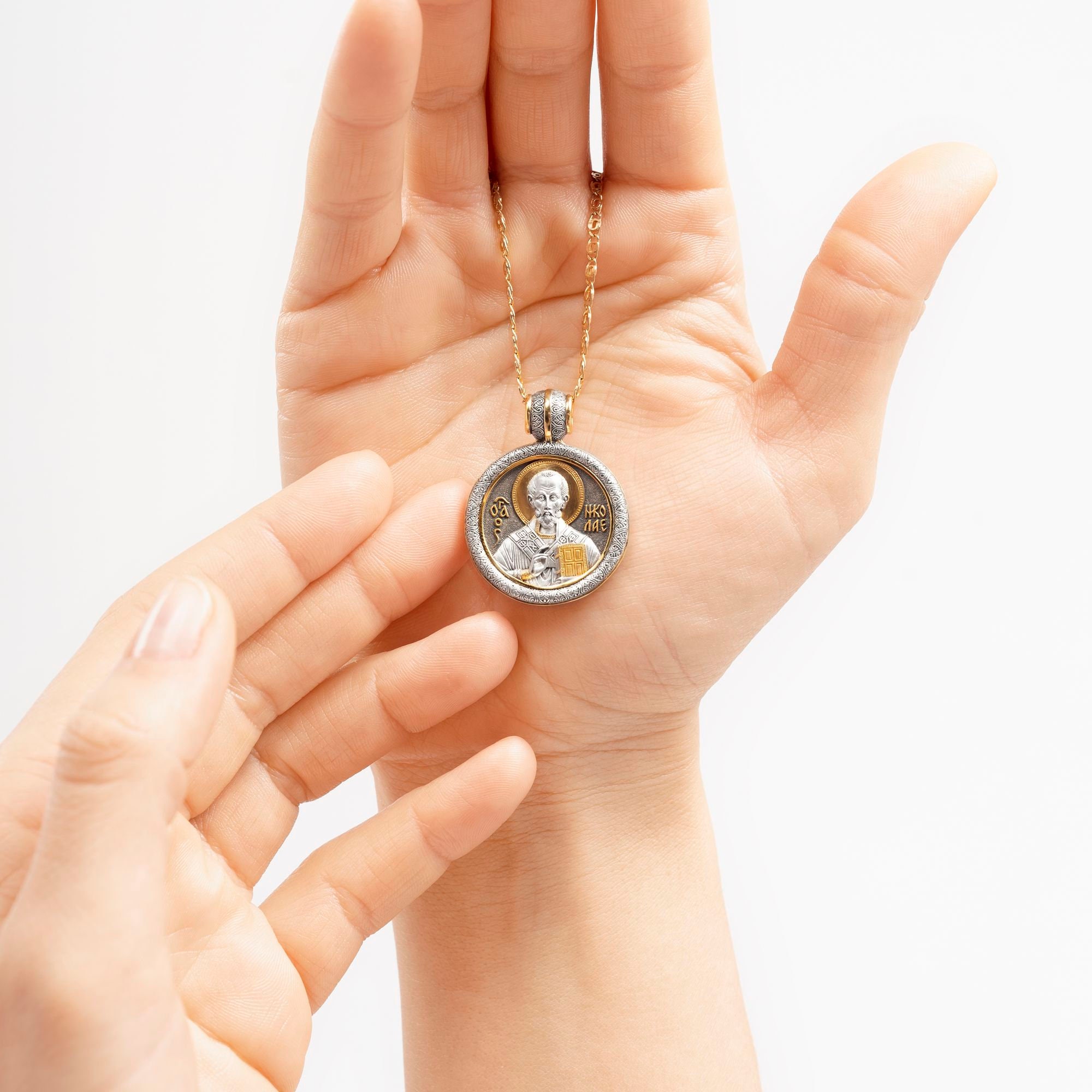
Size: 37×28 mm / 1.46×1.10 in
Weight: ~17,0 g / ~0.60 ozIcon pendant "St. Nicholas the Miracle-Worker. The Seven Sleepers of Ephesus"
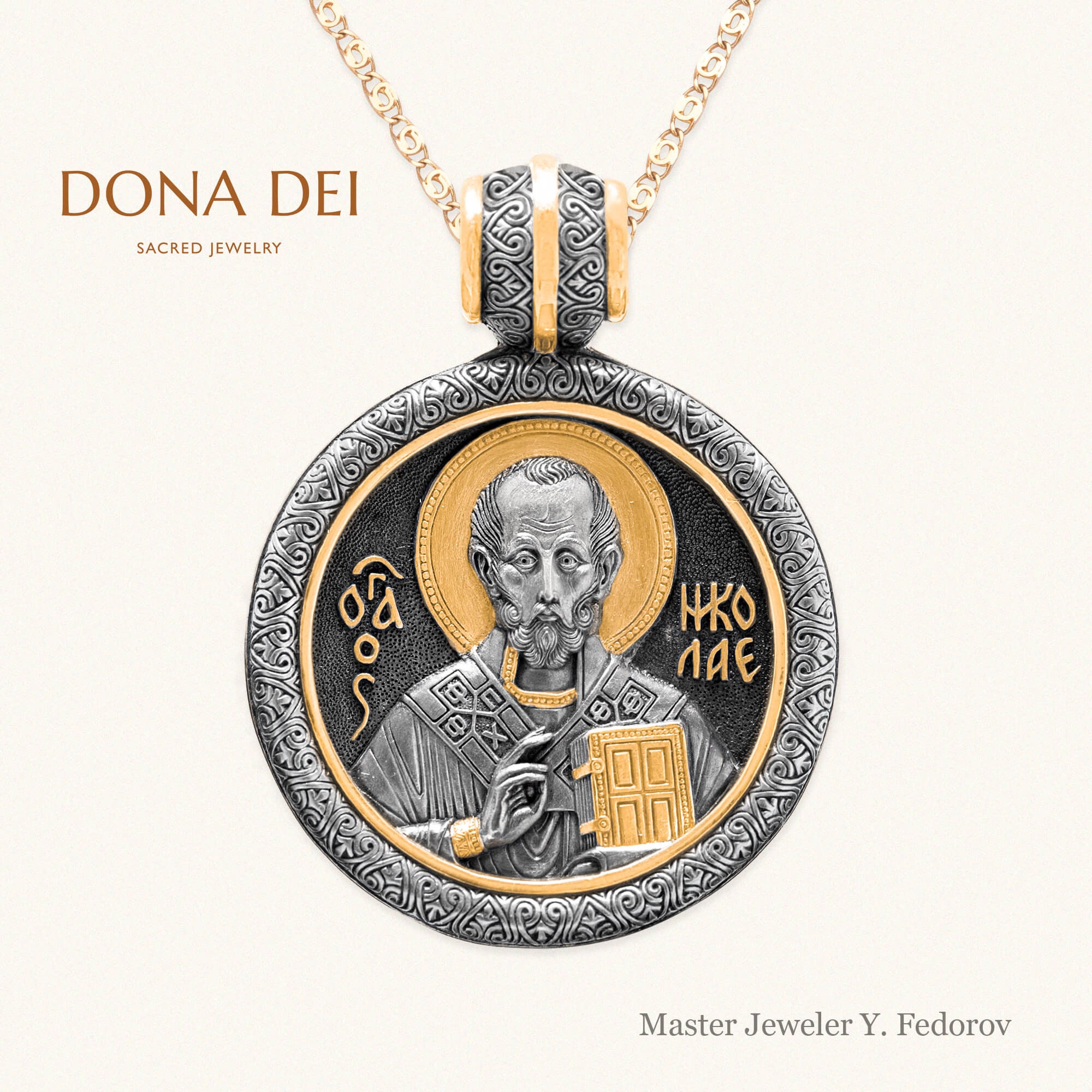
This icon pendant is larger, more detailed, and more festive-looking than our other scapulars. It is a perfect gift for anyone who is ...looking for a more ornate icon of their patron saint. However, the pendant is not intended exclusively for those who share the name of St. Nicholas or wish to pray to him regularly. The iconographic content of the pendant is closely linked to the mystery of the resurrection. This makes the icon pendant "St. Nicholas the Miracle-Worker. The Seven Sleepers of Ephesus" relevant for every Orthodox Christian.
The symbolism of the icon pendant "St. Nicholas the Miracle-Worker. The Seven Sleepers of Ephesus"
The icon is shaped like a circular medallion with a barrel-shaped top. The custom to depict objects that enjoyed particular reverence against the background of a circle has existed since antiquity. One of the reasons behind this was local traditions. For example, Roman and Byzantine soldiers had the custom of raising their emperors on a shield. The Latin word "clipeus" ("round shield") also means "to be marked out", "to be depicted on a shield", or "to be raised on a shield". The round triumphal wreath served as a frame for portraits of great, accomplished, powerful individuals (emperors, generals, philosophers). Another reason was the fact that the circle has long been regarded as a symbol of perfection, eternity, and divinity. Later, the same traditions were applied to portraits of Christ, the Blessed Virgin, the Apostles, and other saints. Indeed, the circular shape itself came to be associated with the halo of glory and holiness.
Traces of these ancient traditions can be seen in our medallion. The round frame of the icon is shaped like a wreath. The shape and composition of the reverse are similar to a round shield. The front of the medallion contains an icon of St. Nicholas the Miracle-Worker, Archbishop of Myra in Lycia. The saint is depicted to his waist in the traditional vestment of a bishop. His right hand is folded into a gesture of blessing, while the left hand, covered with the omophorion, holds the Gospel.
The Holy Archbishop Nicholas is the most revered Christian saint. Only the Theotokos rivals him as the protector and patron of the Church and humankind as such. He is called upon when any of the supplicant's worldly needs have to be met. In prayer he is honored and revered as a "defender of the faithful, wise teacher, guardian of chastity, one who feeds the hungry, consoles the mourning, clothes the naked, heals the sick, directs those sailing the seas, liberates the prisoners, defends and takes care of the widows and orphans, fortifies the old, mentors the fasting, restores the tired, gives abundant wealth to the poor and the disadvantaged". Even the saint's appearance during his earthly life was said to speak of his holiness. "A certain radiant glow emanated from him, and his face shone more than that of Moses," wrote the author of his Greek hagiography.
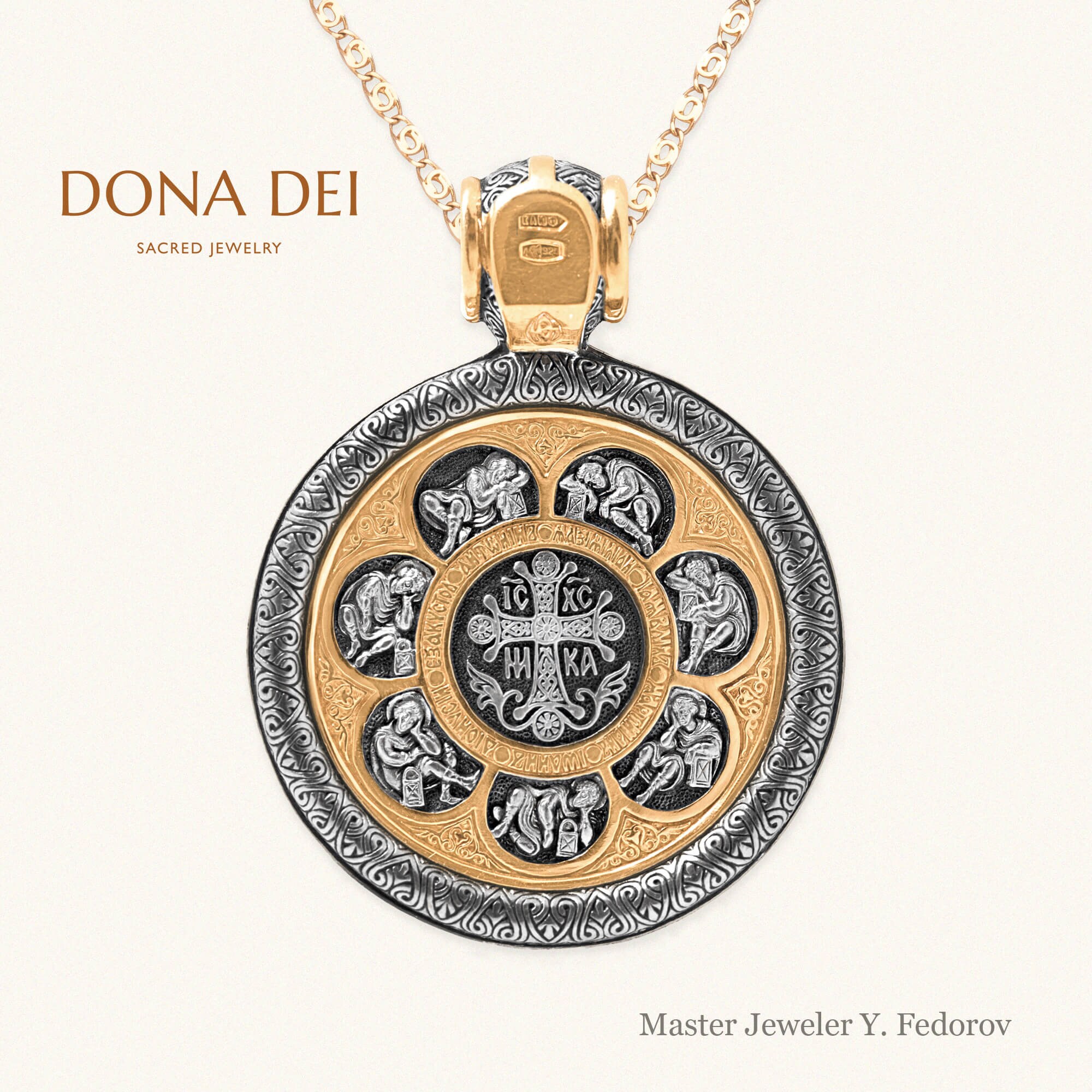
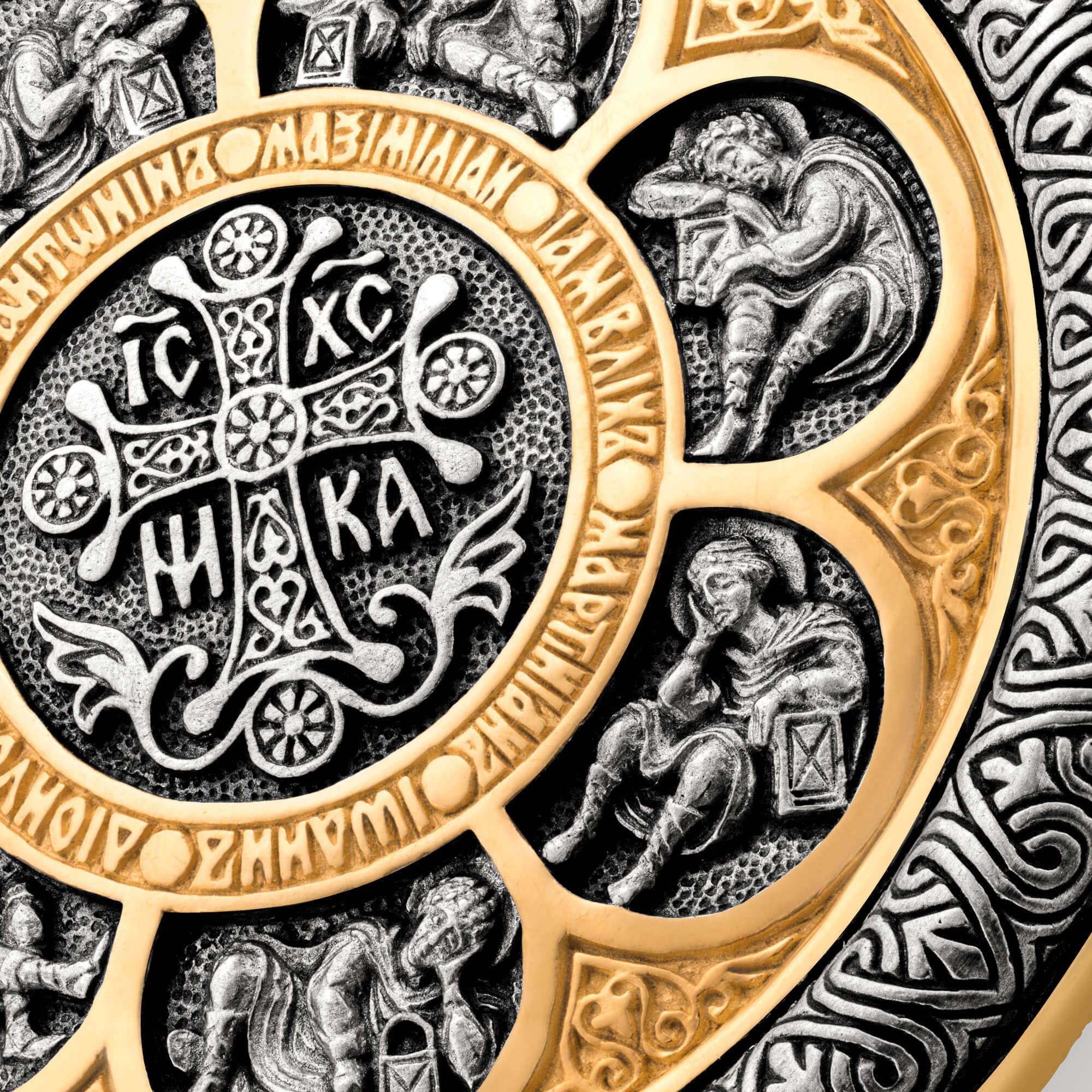
In our item, we have chosen to draw the oft-made parallel between St. Nicholas and the idea of resurrection. In particular, we have depicted him among the sleeping youths of Ephesus, who serve as a symbol of the future resurrection. In keeping with tradition, we have placed "The Seven Sleepers of Ephesus" on the back of the icon. This serves to emphasize that resurrection and the salvation of the soul are the main themes of our item. The composition of the reverse is centered around the blossoming Cross of the Lord. This specific form of the cross is a symbol of Christ's resurrection and the universal resurrection promised by the Savior. The cross is contained in a ring with the names of the holy youths in Church Slavonic. Opposite each name, there is an arch with the image of the sleeping youth. Taken as a whole, the composition forms a seven-petalled flower. This helps convey the idea of resurrection along with the positive symbolism of the number seven.
For a correct understanding of the iconographic plot, let us briefly recall the story of the seven Ephesian youths. They were children of noble Ephesian townspeople who lived in the 3rd century. All of them served in the armed forces and were friends. When Emperor Decius (249-251) ordered sacrifices to be made to pagan gods, the young men refused. As a punishment, they were demoted but released in the hopes that they would denounce Christ voluntarily. The young men withdrew to a remote cave to prepare themselves for the feat of martyrdom through fasting and prayer. When the emperor found out, he ordered the entrance to the cave to be sealed. However, the Lord put the youths into a state of supernatural sleep, which lasted for 170 years. Under Emperor Theodosius, the Younger (408-450), heretics appeared who denied the future resurrection of the dead. It was then that the cave opened and the young men awoke, having been asleep almost for two centuries. Everyone rejoiced at the realization that God had used their miraculous awakening to reveal the mystery of the future resurrection.
A special protective effect was attributed to the image of the sleeping Ephesian youths. After all, in refusing to worship the pagan gods, they had disgraced the devil and won a victory over death. The sleepers of Ephesus were depicted on so-called "serpentine ornaments" used to protect human health and life along with the holy demon fighters. Later, the icon was depicted on a variety of small scapulars used as amulets.
The memory of the youths is celebrated by the Church on 04 (17) August and on 22 October (04 November), the day of their second falling asleep.
The memory of St. Nicholas the Wonder-Worker is celebrated on 06 (19) December and 09 (2) May when his relics were transferred to the city of Bari in 1087.
Technical details of the icon pendant "St. Nicholas the Miracle-Worker. The Seven Sleepers of Ephesus"
The pendant is crafted from grade 925 silver, with the relief icons on either side decorated with blackening. The gilding on the surface is rather extensive. The halo around the saint's head, his bracelet, and the neckband of his robe are plated with 24kt gold. So are the salary of the Gospel in his hand and the inscriptions to his left and right. Likewise, the circle on the reverse that encloses the cross and contains the seven arches with the sleeping youths is also gilded. A gilded band runs around the internal circumference of the medallion on the front and along the middle and both edges of the top part.
The scapular is larger and heavier than our other wearable icons. The dimensions are 1.46×1.10 in (37×28 mm) and the weight is around 0.60 oz (14 g). However, the icon pendant is still convenient to wear and can be hidden under one's clothes without difficulty.